If you have ever managed a WordPress site, a custom SaaS landing page, or an agency contact form, you know the daily reality:
According to cybersecurity research from Imperva, automated bots now drive nearly half of all internet traffic worldwide. But on exposed, unprotected web forms, the reality is even starker: well over 90% of incoming submissions are automated machine spam.
Vague guest-post pitches, crypto scams, automated vulnerability probes, and spoofed inquiries inundate business inboxes every single hour. For marketing teams and founders, this constant barrage creates a toxic operational bottleneck—clogging sales CRMs, triggering wasted follow-up notifications, and burying genuine customer inquiries under a mountain of digital garbage.
Twenty years ago, email experienced this exact crisis. Inboxes were unlivable until modern mail filters learned to classify spam at the protocol level.
Yet on the modern web, contact form defense has barely evolved past the early 2000s.
The Flawed Legacy Solution: The Real Cost of CAPTCHA Friction
To stop bots, developers have traditionally turned to one blunt instrument: CAPTCHAs.
Ask any user or business owner how they feel about clicking blurry traffic lights or solving distorted puzzles, and the reaction is universal: pure frustration. But beyond the obvious "yuck" factor, CAPTCHAs introduce a fundamental flaw into business web architecture: they penalize real, paying customers for the misdeeds of malicious bots.
The numbers are undeniable:
-
Conversion Drop: Every extra millisecond of hesitation or puzzle friction directly lowers contact form conversion rates.
-
Third-Party Surveillance: Traditional free CAPTCHA widgets frequently load heavy client-side JavaScript that tracks user behavior across websites, creating privacy compliance headaches under GDPR and modern privacy standards.
-
Bots Bypassed Them Anyway: Modern AI agents and headless browser scripts can solve standard image and text CAPTCHAs faster and more reliably than humans with vision impairments.
As engineers who have managed high-volume WordPress portals and custom web applications for years, we knew there had to be a developer-friendly, zero-friction alternative.
Why make your human visitors prove they are human when an intelligent edge pipeline can classify incoming requests in milliseconds?
That insight became the foundation for SPAM Escudo.
Inside the Engine: The Five-Phase AI Pipeline
Instead of forcing users to solve visual puzzles, SPAM Escudo evaluates incoming submissions behind the scenes. It operates on a fail-fast, tiered defense architecture that filters out 90% of spam in under 20 milliseconds, reserving compute-heavy AI inference exclusively for nuanced, ambiguous messages.
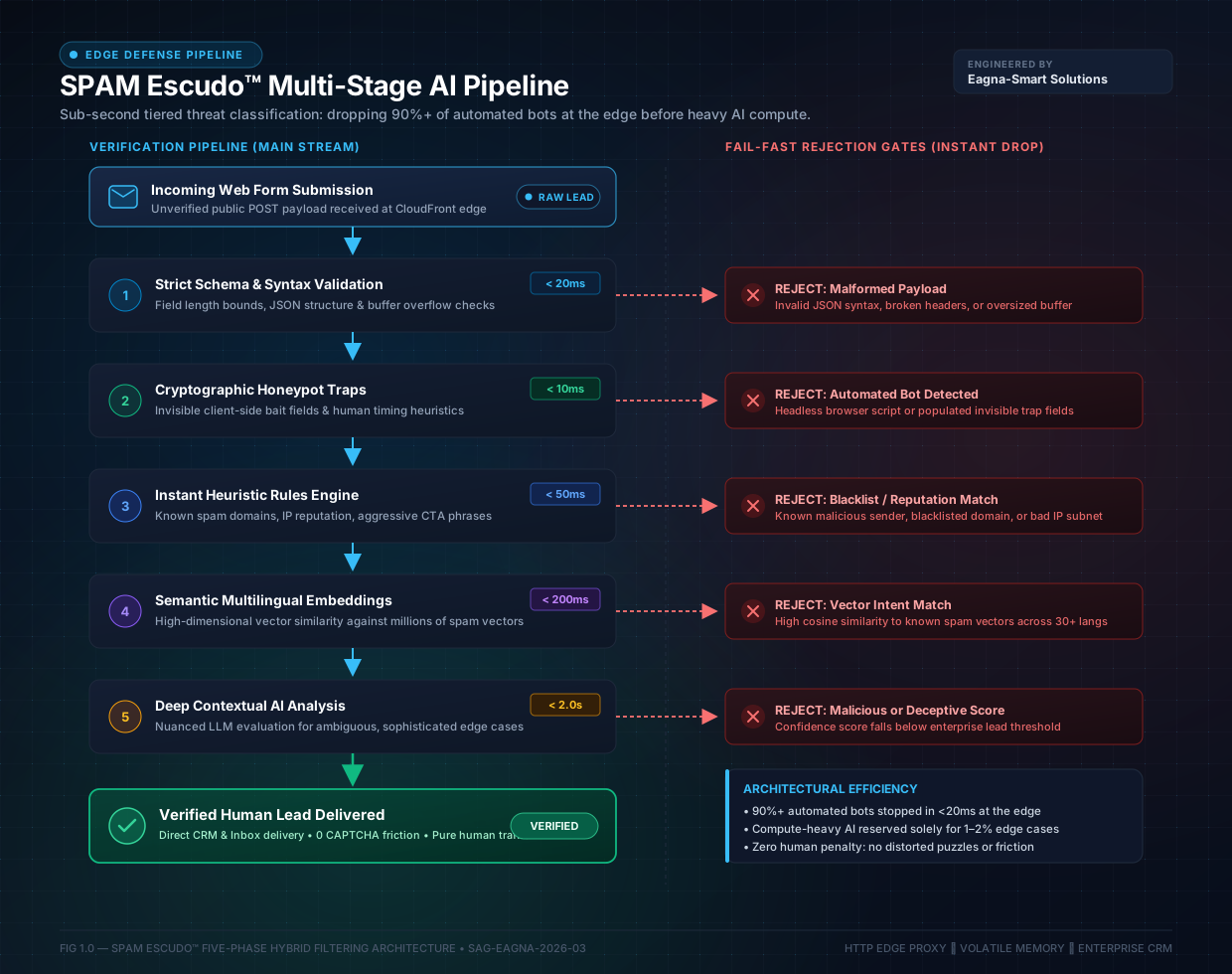
Phase 1: Strict Schema Validation (<20ms avg)
Enforces precise data structure, payload length limits, and field-level validation rules. Any payload attempting buffer overflows, unexpected JSON keys, or broken headers is dropped instantly.
Phase 2: Cryptographic Honeypot Detection (<10ms avg)
Catches automated headless scripts and instant submissions before they ever hit downstream infrastructure. Invisible bait fields and timing heuristics isolate machine-driven bots without disturbing legitimate users.
Phase 3: Instant Rules Engine (<50ms avg)
Executes high-speed pattern matching using customer-configured allowlists/blocklists, known spam domains, aggressive Call-to-Action (CTA) phrase extractors, and reputation databases.
Phase 4: Semantic Multilingual Embeddings (<200ms avg)
This is where traditional rule-based filters fail and SPAM Escudo excels. Using high-dimensional vector similarity, our model converts the incoming message intent into semantic embeddings and compares it against millions of known spam vectors across dozens of languages. It catches spam even when the bot uses synonyms, typos, or obfuscated wording designed to bypass naive keyword blockers.
Phase 5: Deep AI Analysis (<2s avg)
For the rare, highly sophisticated ambiguous message (e.g., a cold pitch written by an LLM that closely mimics a genuine business inquiry), our advanced AI classifier performs a deep contextual evaluation, returning a nuanced confidence score and detailed classification reasoning.
The Result: Zero Friction for Humans, Zero Spam for Inboxes
By moving spam defense from an intrusive frontend challenge to an intelligent backend pipeline, websites using SPAM Escudo enjoy:
-
Higher Conversion Rates: Real leads submit forms effortlessly without ever clicking a distorted photo or waiting for external verification widgets.
-
Instant Sub-Second Latency: Lightweight requests are validated at the edge in less time than it takes a browser to render the submission confirmation.
-
Developer Simplicity: Integrates easily into any modern web framework, WordPress site, or serverless Lambda endpoint via a simple API payload.
Early Access & Design Partner Program
SPAM Escudo is currently running in live production defense across selected partner platforms, including the official Eagna-Smart website contact integration.
We are currently onboarding our initial cohort of Design Partners and Early-Access Users before opening public registration.
If you operate a web agency, run high-traffic WordPress sites, or manage SaaS landing pages inundated by automated form abuse, we invite you to test SPAM Escudo on your infrastructure.
- Request an Early Access Invitation: Visit spamescudo.com or reach out directly to our team at support@eagna-smart.ca (or connect via our contact form).