Twenty days ago, we made a deliberate shift at Eagna-Smart Solutions: after more than a year of engineering software in the background, we began operating in the open.
Every business day over the past four weeks, we published architectural breakdowns, live production data, and honest feature previews across two critical operational bottlenecks that plague growing businesses:
- Inbound Form Spam & Friction: How SPAM Escudo stops bots at the edge before backend databases spin up.
- Outbound Receipt & Financial Fragmentations: How Transit Ledger automates multi-page statements and receipt tracking natively inside Google Sheets™ and Google Drive™ with Zero Database Retention.
Today marks Day 20. As we conclude this initial sprint, we are stepping back from individual product mechanics to ask a fundamental question facing every technical founder, CTO, and CFO:
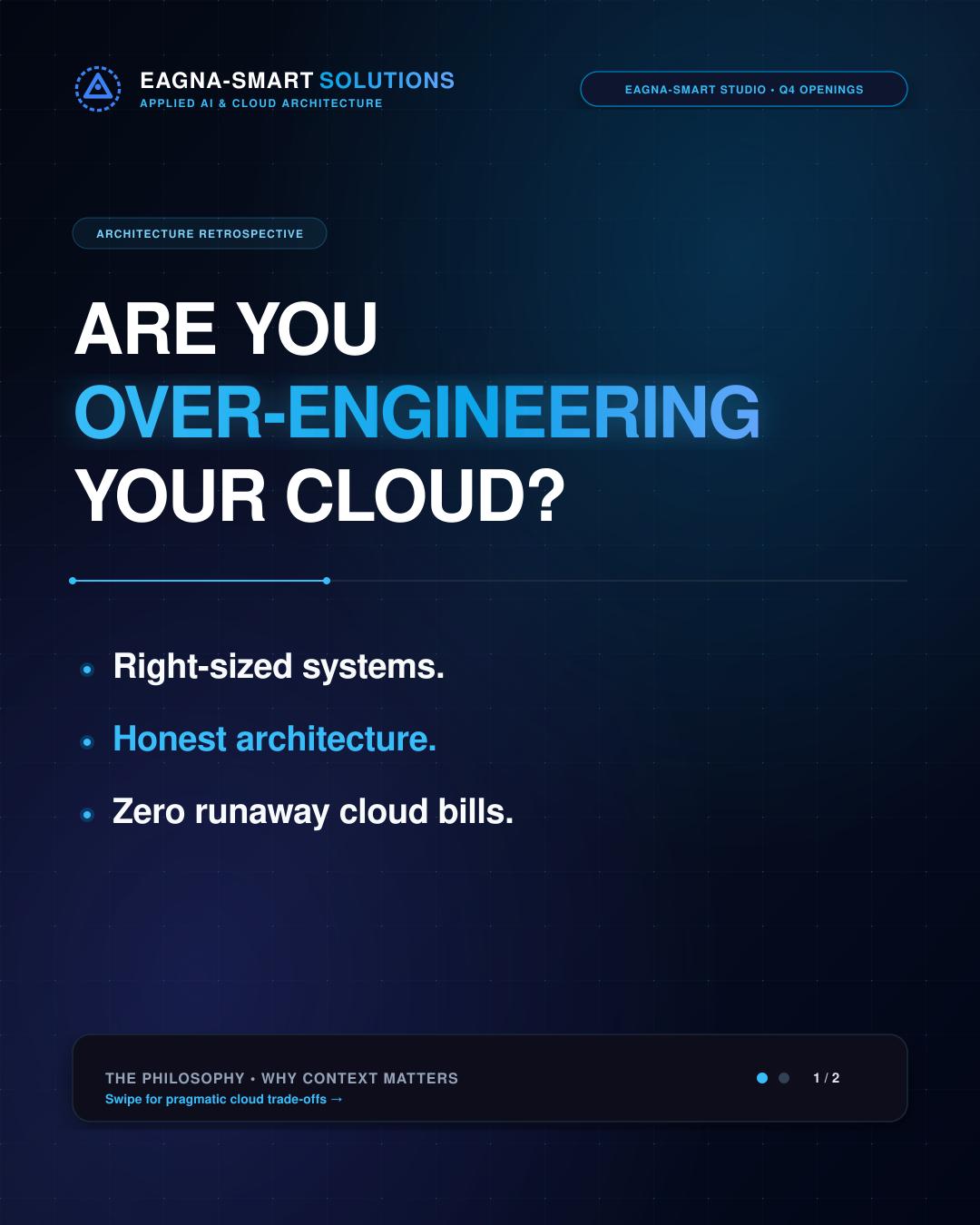
Are you over-engineering your cloud?
Part 1: The Over-Engineering Trap
In modern software development, it has become remarkably easy to confuse architectural complexity with engineering quality.
Too many development teams default to hyperscale enterprise architectures for everyday business requirements:
- Spinning up multi-region Kubernetes clusters for an internal tool with twenty daily active users.
- Slicing simple applications into twelve distributed microservices and message queues before validating market demand.
- Paying $20 to $40 per user each month in SaaS seat taxes just to view records and download PDFs.
- Accumulating astronomical AWS or Google Cloud bills for idle compute, unoptimized data transfers, and bloated relational databases.
The result is always the same: runaway cloud invoices, maintenance gridlock, and fragile systems that burn developer hours instead of driving business velocity.
At Eagna-Smart, our philosophy starts with staccato clarity:
- Right-sized systems: Stop building for 10 million concurrent users when your business has 10,000.
- Honest architecture: Choose the cleanest, most maintainable stack that solves the actual problem.
- Zero runaway cloud bills: Never pay for idle infrastructure or complex services you will never use.
Part 2: There Is No One-Size-Fits-All Cloud
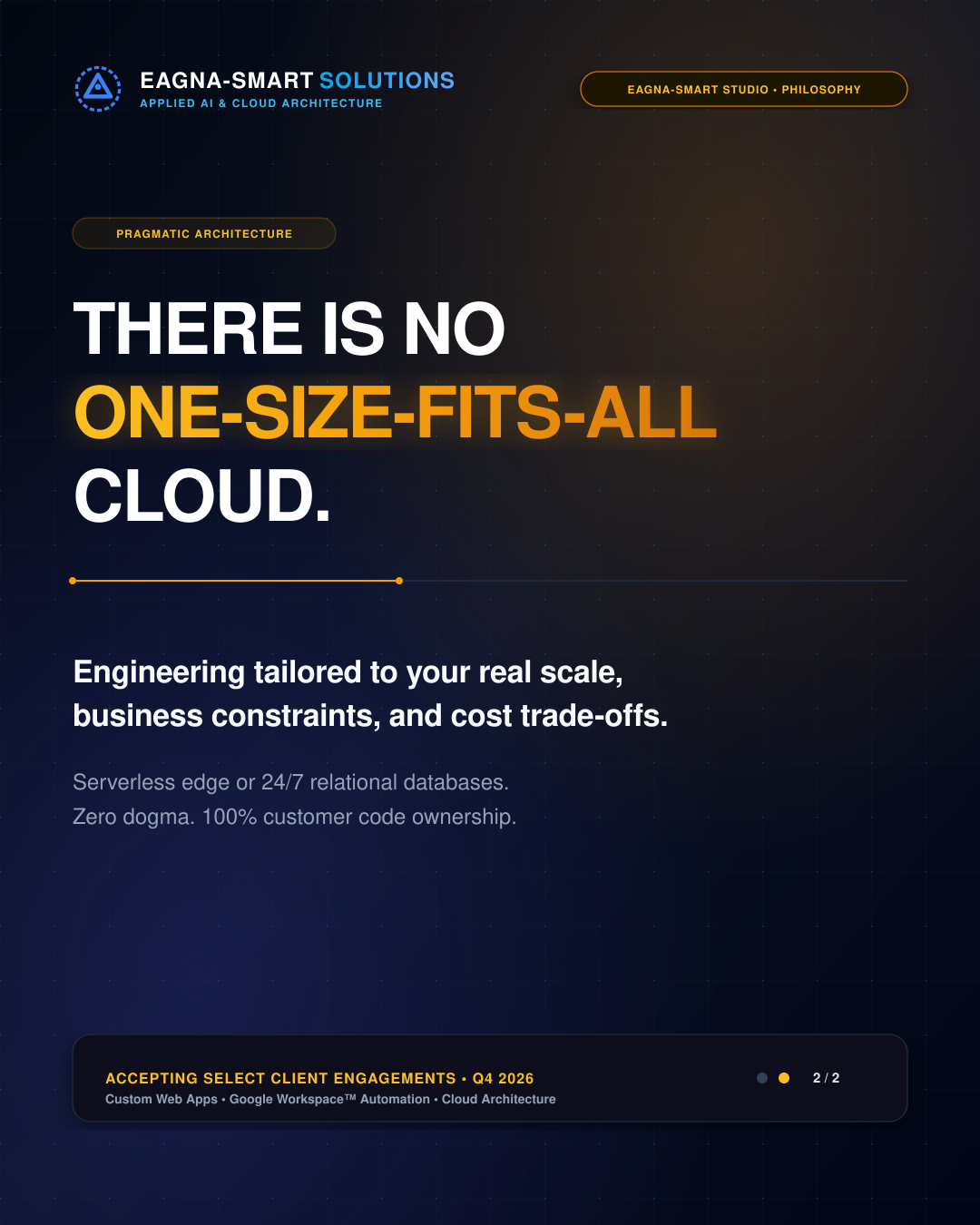
True engineering wisdom (Eagna) means rejecting dogma.
You will never hear us claim that “serverless is the only way” or that “databases are obsolete.” A dogmatic architect is just as dangerous as an over-engineering one.
Different workloads require different trade-offs:
- When Zero Database Retention makes sense: For financial receipts and invoices (Transit Ledger), storing data inside the customer’s own Google Drive™ and Google Sheets™ provides unbeatable data sovereignty and eliminates third-party database liability.
- When Edge Evaluation makes sense: For website contact forms (SPAM Escudo), analyzing payloads in-flight at the CloudFront/Lambda edge stops bots in 45 milliseconds before your database or CRM ever wakes up.
- When 24/7 Relational Databases & Containers are essential: High-frequency transaction ledgers, complex multi-table joins, persistent state engines, and legacy enterprise backends require dedicated relational databases (PostgreSQL/Aurora) or containerized runtimes (Docker/ECS).
We don’t impose a pre-packaged template on your company. We evaluate your real throughput, latency requirements, security posture, and budget to design what your business actually needs.
Part 3: Beyond the “Lift-and-Shift”: The Real Cloud Journey
For many growing organizations, the initial “lift-and-shift” migration was an essential first victory: it shut down aging on-premise server closets, eliminated physical hardware failure risks, and established a foundation in the public cloud.
However, lifting and shifting is only the start of the journey.
When legacy architectures are simply dropped onto 24/7 cloud virtual machines (such as oversized, always-on EC2 instances), companies end up paying an elasticity premium for idle compute. The monthly cloud bill climbs higher than the old hardware costs, and leadership is left wondering why cloud economics failed to deliver.
The real return on investment happens in Phase 2: Cloud-Native Modernization.
Phase 2 is where architecture shifts from passive hosting to intentional engineering:
- Decomposing idle compute: Transitioning batch or sporadic processes to event-driven serverless execution (like AWS Lambda), where compute costs are metered down to the exact millisecond of work.
- Edge-first caching: Shielding relational databases behind CloudFront edge caching, reducing expensive read queries by up to 90%.
- Right-sizing data layers: Aligning state storage with actual workload needs—leveraging customer-owned Google Drive™ and Google Sheets™ for business documents, or managed PostgreSQL/Aurora for high-concurrency relational data.
At Eagna-Smart Studio, we partner with teams to guide Phase 2: taking the systems you already moved to the cloud and optimizing them for real-world economics.
Read Our Architectural Essay: For an in-depth breakdown of the four hidden traps in enterprise migrations, read Pragmatic Cloud Economics: Why Most Cloud Migrations Fail to Lower Costs.
Part 4: What 20 Days Operating in the Open Taught Us
Operating in public every day for four weeks reinforced three core convictions:
-
Customers crave data ownership:
Founders and operators are exhausted by black-box SaaS vendors who hold their data hostage behind export paywalls. When given the choice, teams overwhelmingly prefer architectures where they own the underlying files and tables. -
Applied AI must be practical, not theatrical:
Slapping a generic chat widget on a website is marketing fluff. We use applied AI to do real, unglamorous mechanical work: extracting 40 line items from a crumpled hardware receipt, structuring 4-page bank statements, and classifying spam vectors at the edge. -
100% Code & Infrastructure Sovereignty:
When a company hires an engineering studio, they should never be locked into proprietary agency hosting or secret libraries. You should own 100% of your source code, deployment scripts, and cloud accounts from Day 1.
Part 5: Partner with Eagna-Smart Studio for Q4 2026
With our first 20 days in the open complete, we are officially opening client slots for Q4 2026.
We partner with technical founders, growing agencies, and business operators across three dedicated service tracks:
- 1. Custom Web Applications: Focused management portals, workflow tools, and operational web apps engineered rapidly with modern AI tooling—delivering in weeks what used to take quarters.
- 2. Google Workspace™ Automation: Deep document intelligence and automated routing built directly inside Google Sheets™, Google Drive™, and Gmail™—eliminating data entry and collaborator seat taxes.
- 3. Pragmatic Cloud & Data Architecture: Right-sizing cloud infrastructure, database migrations, serverless backends, and applied AI pipelines designed for minimal idle cost and zero runaway bills.
If you are ready to eliminate operational drag, right-size your architecture, and work with engineers who treat your cloud budget like their own, let’s start a conversation:
👉 Explore Studio Services & Contact Us: https://eagna-smart.ca/#contact
👉 Transit Ledger on Google Workspace Marketplace: Install on Google Workspace Marketplace
Google Workspace™, Google Sheets™, Google Drive™, and Gmail™ are trademarks of Google LLC. Amazon Web Services, AWS™, and related marks are trademarks of Amazon.com, Inc. or its affiliates. All third-party trademarks are used strictly for identification purposes.